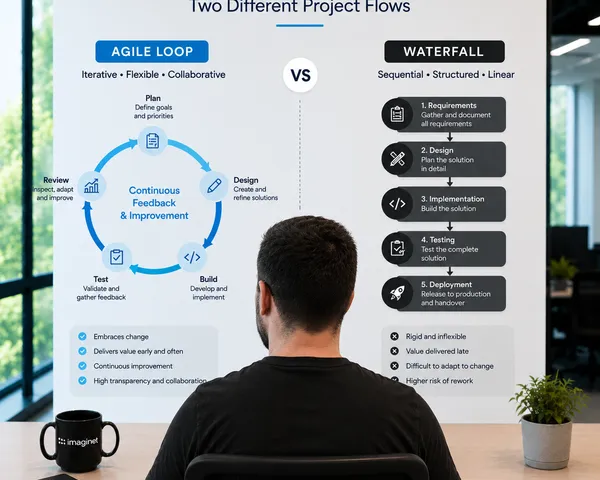
Understanding BDD: Bridging the Gap Between Specifications and Software Behavior
There's a problem that sits quietly at the centre of most software projects. Developers build exactly what was specified. The specification was perfectly clear. And yet what gets delivered isn't quite what anyone actually wanted.
BDD - Behaviour Driven Development - is one of the best tools we have for closing that gap.
What is BDD?
BDD is a development approach that centres around describing software behaviour in plain language before a single line of code is written. Not pseudocode, not technical specs - actual human language that anyone involved in a project top to bottom can read and understand.
The idea is straightforward: if you can describe what a feature should do in plain English, you've forced a level of clarity that technical specs alone rarely achieve. And if developers, testers, and stakeholders are all working from the same description, the chances of building the wrong thing drop significantly.
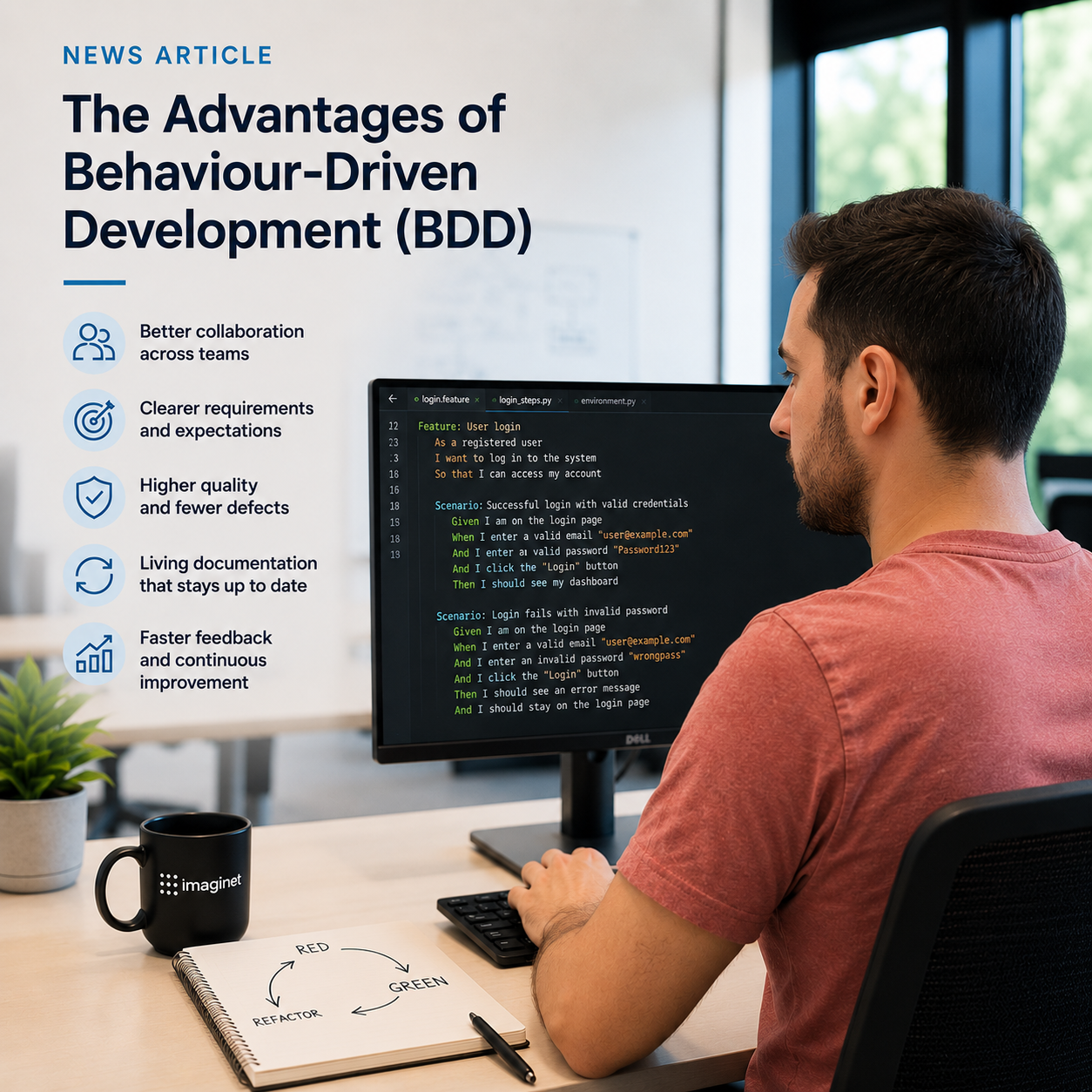
In practice, BDD uses a simple structure called Gherkin. A feature is described as a scenario with three parts - Given, When, Then. Given the context. When something happens. Then this is the expected outcome.
It reads almost like a sentence, which is the point. But there's something deeper going on too.
Stories as journeys in time
The way we think about it at Imaginet: a user story isn't a UI specification. It's a journey in time.
Given describes where the user already is - past tense, context established. When describes what they do - present tense, the action in the moment. Then describes what they experience as a result - future tense, the outcome they can observe.
Every acceptance criterion is a mini walkthrough, not a technical rule. You're not describing a screen - you're describing a moment in a user's experience, and what happens when they move through it. Think user behaviour, not technical steps
This might sound like a subtle distinction, but it changes everything about how stories get written and tested. It prevents circular criteria - you can't assert something that already exists, you describe the change. It stops implementation detail leaking into stories - you describe behaviour, not mechanics. And it maps directly to testing and UAT, reducing interpretation debates before a line of code has been written.
Why it matters?
The gap between 'what was asked for' and 'what was built' is where most software problems live. It's rarely down to poor technical ability. It's almost always a communication problem - something got lost between the conversation in the meeting room and the code in the editor.
BDD makes that gap visible early, when it's cheap to fix. By writing scenarios upfront, teams are forced to surface ambiguity before development starts. Questions that would otherwise surface during testing - or worse, after go-live - get asked in the planning stage.
It also produces a side effect that's genuinely useful: the scenarios become living documentation. As the codebase grows and changes, the BDD scenarios evolve with it. You always have a readable, up-to-date record of how the system is supposed to behave
Who's involved
This is where BDD differs from a lot of development practices - it's not just a technical concern. BDD works best when developers, testers, and product or business stakeholders write the scenarios together. That collaboration is sometimes called the 'three amigos' - each perspective catches things the others miss.
A developer will know what's technically feasible. A tester will think about edge cases and what happens when things go wrong. A product person will keep the focus on what the user actually needs. Get all three in a room with a blank scenario to fill in, and you're far more likely to end up with something that reflects reality.
That collaborative stage - often called refinement - is where a lot of the real value gets generated. Not in the code itself, but in the conversations that happen before it's written.
At Imaginet, this thinking extends into how we approach testing more broadly. There are no gatekeepers. Everyone on the team - developers, QA, delivery - takes responsibility for quality at every stage of the process. BDD is the thread that connects all of it, giving the whole team a shared language and a shared standard to work from.
The bottom line
BDD isn't a silver bullet - no methodology is. It takes discipline to maintain, and it requires genuine collaboration across disciplines to work well. If stakeholders aren't engaged, or if scenarios get written in isolation, you lose most of the benefit.
But when it works, it works well. Teams build with more confidence because the behaviour is defined. Testers have clear criteria to work from. Stakeholders can read and validate the scenarios without needing a technical background. And the finished product tends to actually do what people expected it to do.
Which, when you think about it, should be the minimum bar - but it's harder to hit than it sounds. BDD gives you a fighting chance of getting there.
Why not check out some of our related insights